Mise à jour le : 14-05-2008

Le FibroScan quantifie de façon instantanée et totalement non invasive la fibrose du foie.
Le Principe:
Le principe utilisé est simple : plus le foie est dur, plus la fibrose est importante. Cette relation entre la dureté du foie et le degré de fibrose est à rapprocher de la palpation du médecin.
Pour analyser cette dureté, on utilise un paramètre clè qui est l'élasticité qui dépend de l'état pathologique des tissus
Plus un milieu est dur plus son élasticité augmente, ce qui peut paraître paradoxal dans le language courant mais il s'agit ici de physique.
Cette élasticité s’exprime en Kilo Pascal (kPa) comme une pression
En résumant :
L'élasticité correspond en physique à la capacité d’un milieu à se déformer lorsqu’on lui applique une contrainte mécanique
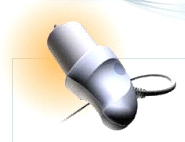
Pour mesurer cette élasticité du foie, le FibroScan utilise une nouvelle technologie brevetée, l'élastométrie impulsionnelle. Celle-ci consiste à engendrer une petite vibration à la surface de la peau qui va se propager dans le foie. Cette vibration est obtenu par un vibreur situé sur une sonde.
Puis à l'aide du Transducteur qui émet et reçoit les ultrasons, on mesure la vitesse de déplacement (la vitesse est mesurée entre deux points qui sont visualisés dans le Film ci-dessous par les deux cibles).
Plus cette vibration se déplace rapidement, plus le foie est dur.
La Machine:
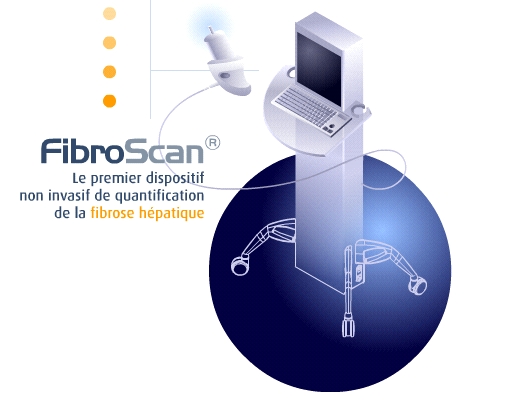
La machine est constituée d'un écran que nous détaillerons plus loin, d'un clavier avec un trackBall, un lecteur de Cdrom avec des interfaces USB permettant de brancher une imprimante et une clés USB et un ordinateur associant une carte d'acquisition des ultrasons permettant le traitement du signal numérique.
L'écran se compose en haut d'un interface en noir et blanc d'échographie en mode TM permettant de visualiser le parenchyme hépatique avec un aspect typique en "millefeuille". La pression exercée par l'opérateur est contrôlée, en effet une jauge de Pression permet de visualiser en vert la bonne pression que l'on applique sur la peau avec la sonde. Ceci est important car si la pression est trop faible ou trop forte le vibreur ne peut pas envoyer dans de bonne condition l'impulsion.
Quand l'opérateur est bien devant le foie avec un pression valable il peut déclancher, en appuyant sur un bouton situé sur la sonde, l'impulsion sur la peau. Le résultat obtenu est une pression en kPa avec un objectif d'avoir 20 mesures valides.
Le résultat donné est une médiane. S'il existe une trop grande discordance entre les différentes prise de mesure il faut réaliser de nouveau 10 mesures valide pour obtenir une médiane sur 30 mesures.
Le FibroScan est un instrument très fiable
La mesure de la dureté est une mesure quantitative d'un paramètre physique concret et précis.
D'autre part, elle est faite directement dans le foie et n'est pas influençable par des conditions extra-hépatiques.
Elle explore un volume hépatique > 3cm2 comme nous le voyons sur le shémas précédent.
Les avantages
Les avantages de l'utilisation du FibroScan sont nombreux :
1. La mesure est entièrement non invasive (pas de prise de sang) et totalement indolore pour le patient.
2. L'examen est très simple et s'apparente à un examen doppler. Il ne prend que 5 minutes.
3. Le résultat de la mesure est connu immédiatement
4. La mesure peut être faite au cours d'un traitement pour évaluer l'impact anti-fibrosant d'une thérapie
5. La mesure peut être faite aussi souvent que nécessaire
L'examen en Pratique
Les mesures sont réalisées sur le coté droit au niveau du foie par voie intercostale.
Le patient est allongé sur le dos avec le bras droit relevé derrière la tête.
La sonde est perpendiculaire à la surface de la peau.
L’examen est réalisé au moins deux heures après un repas.
Si le patient est stressé, il peut être utile de faire les mesures en apnée.
L’opérateur doit réaliser 20 mesures valides.
Le patient perçoit la percussion du vibreur sur la peau de façon totalement indolore.
- Film : Comment se déroule un examen par Fibroscan (Allez dans l'Espace Film)
- Plaquette d'explication de l'examen du Fibroscan en format Pdf -
Les résultats
Les mesures terminées le médecin doit analyser vos résultats selon votre pathologie. Il se servira de la médiane obtenue en KPa pour évaluer le niveau de fibrose hépatique. Une élasticité de 3kPa correspondra à une fibrose F0 en revanche une élasticité de l'ordre de 14 kPa correspondra à une fibrose sévère F4.
Exemple de correspondance d'élasticité et de niveau de Fibrose
![]()
Documents scientifiques
Listes des communications et publications en format Pdf -
Listes des communications à AASLD 2006 en format Pdf -
Articles :
L. Castera, J. Vergniol, J. Foucher, B. Le Bail, E. Chanteloup, M. Haser, M. Darriet, P. Couzigou and V. de Ledinghen.
Prospective comparison of transient elastography, Fibrotest, APRI and liver biopsy for the assessment of fibrosis in chronic hepatitis C.
Gastroenterology 2005;128:343-350.
Abstract Background & Aims: Transient elastography (FibroScan®) is a novel, non-invasive and rapid bedside method to assess liver fibrosis by measuring liver stiffness. We prospectively assessed the performance of FibroScan® in patients with chronic hepatitis C, in comparison to and combined with currently available biochemical markers (Fibrotest® and APRI index); liver biopsy performed the same day served as the reference. Methods: We studied 183 consecutive patients with chronic hepatitis C (METAVIR fibrosis stage F1 n=47, F2 n=53, F3 n=37, F4 n=46). Results: FibroScan® values ranged from 2.4 to 75.4 kPa (median: 7.4 kPa). Cut-off values were 7.1 kPa for F>=2, 9.5 kPa for F>=3 and 12.5 kPa for F=4. The areas under the ROC curve of FibroScan®, FibroTest and APRI values were of the same order (0.83, 0.85 and 0.78, respectively, for F>=2; 0.90, 0.90 and 0.84, respectively, for F>=3; 0.95, 0.87 and 0.83, respectively, for F=4). The best performance was obtained by combining FibroScan® and FibroTest®, with areas under the ROC curve of 0.88 for F>=2, 0.95 for F>=3, and 0.95 for F=4. When the FibroScan® and FibroTest® results agreed, liver biopsy confirmed them in 84% of cases for F>=2, 95% for F>=;3, and 94% for F=4. Conclusions: FibroScan® is a simple and effective method for assessing liver fibrosis, with similar performance to FibroTest® and APRI. Combined use of FibroScan® and FibroTest® to evaluate liver fibrosis could avoid biopsy in most patients with chronic hepatitis C.
M. Ziol, A. Handra-Luca, A. Kettaneh, C. Christidis, F. Mal, F. Kazemi, V. de Ledinghen, P. Marcellin, D. Dhumeaux, J.C. Trinchet and M. Beaugrand.
Non-invasive assessment of liver fibrosis by stiffness measurement: a prospective multicentre study in patients with chronic hepatitis C.
Hepatology 2005;41(1):48-54.
Abstract Because liver fibrosis is the main reliable predictor of the progression of chronic hepatitis C, its assessment by liver biopsy (LB) is proposed to help determine therapy. However, biopsy is an invasive procedure with several limitations. A new, non-invasive medical device based on transient elastography has been designed to measure liver stiffness. The aim of this study was to investigate the use of liver stiffness measurement (LSM) in the evaluation of liver fibrosis in patients with chronic hepatitis C. We prospectively enrolled 327 patients with chronic hepatitis C in a multicentre study. Patients underwent LB and LSM. METAVIR liver fibrosis stages were assessed on biopsy specimens by 2 pathologists. LSM were performed by transient elastography. Efficiency of LSM and optimal cut-off values for fibrosis stage assessment were determined by a receiver-operating characteristics (ROC) curve analysis and cross-validated by the jack-knife method. LSM was well correlated with fibrosis stage (Kendall correlation coefficient: 0.55, p < 0.0001). The area under ROC curves were 0.79 (95% confidence interval: 0.73-0.84) for F >= 2, 0.91 (0.87-0.96) for F >= 3, and 0.97 (0.93-1) for F = 4 and for larger biopsies, these values were respectively 0.81, 0.95 and 0.99. Optimal stiffness cut-off values of 8.7 and 14.5 kPa showed F >= 2 and F = 4, respectively. In conclusion, non-invasive assessment of liver stiffness with transient elastography appears reliable to detect significant fibrosis or cirrhosis in patients with chronic hepatitis C.
H. Saito, S. Tada, N. Nakamoto, K. Kitamura, H. Horikawa, S. Kurita, Y. Saito, H. Iwai and H. Ishii.
Efficacy of non-invasive elastometry on staging of hepatic fibrosis.
Hepatology Research 2004;29:97-103.
Abstract To assess the efficacy of elastometry in the determination of fibrotic stage in the liver, we investigated correlation between liver histology and the elastometry using a device equipped with a vibrator and an echogram (Echosens, Paris, France) in patients with chronic hepatitis C. Totally 75 patients, 24 in F1 stage, 17 in F2 stage, 18 in F3 stage, and 16 in F4 stage according to the new Inuyama classification without fatty change were investigated. Correlations between the staging of liver fibrosis and elastometry, serum fibrosis makers and platelet counts were investigated. The elastometry was absolutely non-invasive. Serum fibrosis markers did not well correlate with the stage of liver fibrosis. Platelet counts significantly (p < 0.0001).
L. Sandrin, B. Fourquet, J.M. Hasquenoph, S. Yon, C. Fournier, F. Mal, C. Christidis, M. Ziol, B. Poulet, F. Kazemi, M. Beaugrand and R. Palau.
Transient elastography: a new non-invasive method for assessment of hepatic fibrosis. Ultrasound in Medicine and Biology 2003;29(12):1705-1713.
Abstract Chronic hepatitis is accompanied by progressive deposit of hepatic fibrosis, which may lead to cirrhosis. Evaluation of liver fibrosis is thus of great clinical interest and up to now is assessed with liver biopsy. This work aims to evaluate a new non-invasive device to quantify liver fibrosis: the shear elasticity probe or FibroScan®. This device is based on one-dimensional transient elastography, a technique that uses both ultrasound (5 MHz) and low-frequency (50 Hz) elastic waves, which propagation velocity is directly related to elasticity. The intra and inter-operator reproducibility of the technique as well as its ability to quantify liver fibrosis were evaluated in 106 patients with HCV chronic hepatitis. Liver elasticity measurements are reproducible (standardized coefficient of variation: 3%), operator-independent and well correlated (r = 0.81, p << 0.0001) to fibrosis grade (METAVIR). The areas under the ROC curves are 0.88 and 0.99 for the diagnosis of patients with significant fibrosis (>= F2) and with cirrhosis (= F4) respectively.
L. Sandrin, M. Tanter, J.L. Gennisson, S. Catheline and M. Fink.
Shear elasticity probe for soft tissues with 1-D transient elastography.
IEEE UFFC 2002;49:436-446.
Abstract Important tissue parameters such as elasticity can be deduced from the study of the propagation of low frequency shear waves. A new method for measuring the shear velocity in soft tissues is presented in this paper. Unlike conventional transient elastography in which the ultrasonic transducer and the low frequency vibrator are two separated parts, the new method relies on a probe that associates the vibrator and the transducer, which is built on the axis of the vibrator. This setup is easy to use. The low frequency shear wave is driven by the transducer itself that acts as a piston while it is used in pulse echo mode to acquire ultrasonic lines. The results obtained with the new method are in good agreement with those obtained with the conventional one.
M. Beaugrand, M. Ziol, L. Sandrin, C. Fournier, A. Biaggi-Frassati, B. Poulet,
J.C. Trinchet, F. Mal, C. Christidis, F. Kazemi, V. Grando, N. Ganne and R. Palau.
Liver elasticity measurements by ultrasonic transient elastography: a new non-invasive method
for assessment of liver fibrosis in chronic viral hepatitis.
54th Annual Meeting of the American Association for the Study of Liver Diseases. United-State, Boston, October 24 28, 2003.M. Beaugrand, R. Palau, F. Mal, C. Christidis, M. Ziol, L. Sandrin, C. Fournier
and B. Fourquet.
Transient elastrography a new non invasive method for assessment of liver fibrosis:
results in patients with HCV chronic hepatitis.
38th Annual Meeting of the European Association for the Study of Liver. Switzerland, Geneva, July 3 6, 2003.C. Christidis, L. Sandrin, R. Palau, M. Ziol, B. Fourquet, F. Mal, P. Callard, M. Beaugrand, C. Fournier, B. Gayet.
L'élasticité du foie est-elle un reflet de la fibrose hépatique ou peut-on évaluer la fibrose par une méthode non invasive ? Résultat d'une étude pilote par élastographie.
Journées francophones de pathologie digestive, 27ème édition. France, Paris, March 29 April 2, 2003.M. Beaugrand
Elastometry: an alternative to liver biopsy for the evaluation of hepatic fibrosis in HCV patients.
Highly Advanced Medical Technologies. Japan, Tokyo, February 14, 2003.R. Palau
The experience of a radiologist with the elastometer. An application of transient elastography.
Highly Advanced Medical Technologies. Japan, Tokyo, February 14, 2003.R. Palau, L. Sandrin, J.M. Hasquenoph, S. Yon, C. Fournier and B. Fourquet.
Noninvasive Tissue Elasticity Probe
Radiological Society of North America. 88th Scientific Assembly and Annual Meeting. USA, Chicago, December 1-6, 2002.C. Christidis, F. Mal, M. Beaugrand, N. Bouzar, C. Strauss, G, Seguin, S. Lenoir,
L. Fontanelle, M. Zins, R. Palau, L. Sandrin, C. Fournier and B. Fourquet.
Noninvasive Evaluation of the Hepatic Fibrosis Using Transient Elastography.
Radiological Society of North America. 88th Scientific Assembly and Annual Meeting. USA, Chicago, December 1-6, 2002.
Où trouver le Fibroscan
Hôpitaux possèdant le Fibroscan (Classé par Départements) : Cliquez ici
Site Internet:
Pour plus de renseignements sur la société EchoSens : Cliquez ici
Adresse de la société:
Le FibroScan est produit par EchoSens, société française située à Paris.
ECHOSENS
153, avenue d'Italie
75013 Paris - France