Copyright
© 2003 Echosens
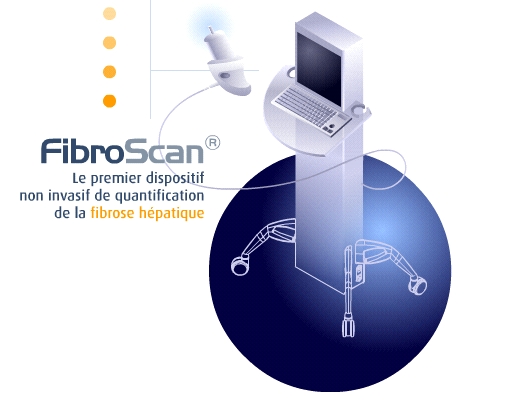
Le FibroScan quantifie de façon
instantanée et totalement non invasive la fibrose du foie.
Principe
:
Le principe utilisé est
simple : plus le foie est dur, plus la fibrose est importante.
Copyright ©
2003 Echosens
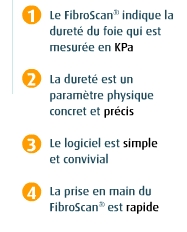
Le FibroScan mesure la dureté
du foie et donne un résultat en kPa, l'unité de
mesure de la dureté.
Cette relation entre la dureté du foie et le degré
de fibrose est à rapprocher de la palpation du médecin.
Une étude clinique préliminaire, qui sera publiée
cet automne dans la revue « Ultrasound in Medicine and
Biology », valide cette relation (cf site www.echosens.com
). D'autres études cliniques de plus grande envergure
sont en cours.
Pour mesurer la dureté
du foie, le FibroScan utilise une nouvelle technologie brevetée,
l'élastométrie impulsionnelle. Celle-ci consiste
à engendrer une petite vibration à la surface de
la peau qui va se propager jusque dans le foie. A l'aide d'ultrasons,
on en mesure la vitesse de déplacement. Plus cette vibration
se déplace rapidement, plus le foie est dur.
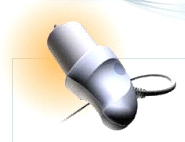
Sonde - Copyright
© 2003 Echosens
Le FibroScan
semble être un instrument très fiable :
La mesure de la dureté est une mesure quantitative d'un
paramètre physique concret et précis.
D'autre part, elle est faite directement dans le foie et n'est
pas influençable par des conditions extra-hépatiques.
Avantage
Les avantages de l'utilisation
du FibroScan sont nombreux :
1. La mesure est entièrement non invasive (pas de prise
de sang) et totalement indolore pour le patient.
2. L'examen est très simple et s'apparente à un
examen doppler. Il ne prend que 5 minutes.
3. Le résultat de la mesure est connu immédiatement
4. La mesure peut être faite au cours d'un traitement pour
évaluer l'impact anti-fibrosant d'une thérapie
5. La mesure peut être faite aussi souvent que nécessaire
Le FibroScan est homologué
et commercialisable dès maintenant.
Interface utilisateur
- Copyright © 2003 Echosens
Copyright
© 2003 Echosens
DOCUMENTS
SCIENTIFIQUES
Articles :
L. Sandrin, B. Fourquet, J.M.
Hasquenoph, S. Yon, C. Fournier, F. Mal, C. Christidis, M. Ziol,
B. Poulet, F. Kazemi, M. Beaugrand and R. Palau.
Transient elastography:
a new non-invasive method for assessment of hepatic fibrosis.
(accepted in Ultrasound in Medicine and Biology)
Abstract -Chronic hepatitis is accompanied by progressive
deposit of hepatic fibrosis, which may lead to cirrhosis. Evaluation
of liver fibrosis is thus of great clinical interest and up to
now is assessed with liver biopsy. This work aims to evaluate
a new non-invasive device to quantify liver fibrosis: the shear
elasticity probe or FibroScan®. This device is based on one-dimensional
transient elastography, a technique that uses both ultrasound
(5 MHz) and low-frequency (50 Hz) elastic waves, which propagation
velocity is directly related to elasticity. The intra and inter-operator
reproducibility of the technique as well as its ability to quantify
liver fibrosis were evaluated in 106 patients with HCV chronic
hepatitis. Liver elasticity measurements are reproducible (standardized
coefficient of variation: 3%), operator-independent and well
correlated (r = 0.81, p << 0.0001) to fibrosis grade (METAVIR).
The areas under the ROC curves are 0.88 and 0.99 for the diagnosis
of patients with significant fibrosis (>= F2) and with cirrhosis
(= F4) respectively.
L. Sandrin, M. Tanter, J.L.
Gennisson, S. Catheline and M. Fink.
Shear elasticity probe
for soft tissues with 1-D transient elastography.
IEEE UFFC 2002;49:436-446.
Abstract -Important tissue parameters such as elasticity
can be deduced from the study of the propagation of low frequency
shear waves. A new method for measuring the shear velocity in
soft tissues is presented in this paper. Unlike conventional
transient elastography in which the ultrasonic transducer and
the low frequency vibrator are two separated parts, the new method
relies on a probe that associates the vibrator and the transducer,
which is built on the axis of the vibrator. This setup is easy
to use. The low frequency shear wave is driven by the transducer
itself that acts as a piston while it is used in pulse echo mode
to acquire ultrasonic lines. The results obtained with the new
method are in good agreement with those obtained with the conventional
one.
Conférences :
M. Beaugrand, M. Ziol, L.
Sandrin, C. Fournier, A. Biaggi-Frassati, B. Poulet,
J.C. Trinchet, F. Mal, C. Christidis, F. Kazemi, V. Grando, N.
Ganne and R. Palau.
Liver elasticity measurements
by ultrasonic transient elastography: a new non-invasive method
for assessment of liver fibrosis in chronic viral hepatitis.
54th Annual Meeting of the American Association for the Study
of Liver Diseases. United-State, Boston, October 24 28,
2003.
M. Beaugrand, R. Palau, F.
Mal, C. Christidis, M. Ziol, L. Sandrin, C. Fournier
and B. Fourquet.
Transient elastrography
a new non invasive method for assessment of liver fibrosis:
results in patients with HCV chronic hepatitis.
38th Annual Meeting of the European Association for the Study
of Liver. Switzerland, Geneva, July 3 6, 2003.
C. Christidis, L. Sandrin,
R. Palau, M. Ziol, B. Fourquet, F. Mal, P. Callard, M. Beaugrand,
C. Fournier, B. Gayet.
L'élasticité
du foie est-elle un reflet de la fibrose hépatique ou
peut-on évaluer la fibrose par une méthode non
invasive ? Résultat d'une étude pilote par élastographie.
Journées francophones de pathologie digestive, 27ème
édition. France, Paris, March 29 April 2, 2003.
M. Beaugrand
Elastometry: an alternative
to liver biopsy for the evaluation of hepatic fibrosis in HCV
patients.
Highly Advanced Medical Technologies. Japan, Tokyo, February
14, 2003.
R. Palau
The experience of
a radiologist with the elastometer. An application of transient
elastography.
Highly Advanced Medical Technologies. Japan, Tokyo, February
14, 2003.
R. Palau, L. Sandrin, J.M.
Hasquenoph, S. Yon, C. Fournier and B. Fourquet.
Noninvasive Tissue
Elasticity Probe
Radiological Society of North America. 88th Scientific Assembly
and Annual Meeting. USA, Chicago, December 1-6, 2002.
C. Christidis, F. Mal, M.
Beaugrand, N. Bouzar, C. Strauss, G, Seguin, S. Lenoir,
L. Fontanelle, M. Zins, R. Palau, L. Sandrin, C. Fournier and
B. Fourquet.
Noninvasive Evaluation
of the Hepatic Fibrosis Using Transient Elastography.
Radiological Society of North America. 88th Scientific Assembly
and Annual Meeting. USA, Chicago, December 1-6, 2002.
Sites internet :
Pour plus de renseignements sur
la technologie et la société EchoSens : Cliquez ici
Adresse
de la société :
Le FibroScan est produit par
EchoSens, société française située
à Paris. Tél 01 58 65 00 77 Fax : 01 58 65 00 84

